
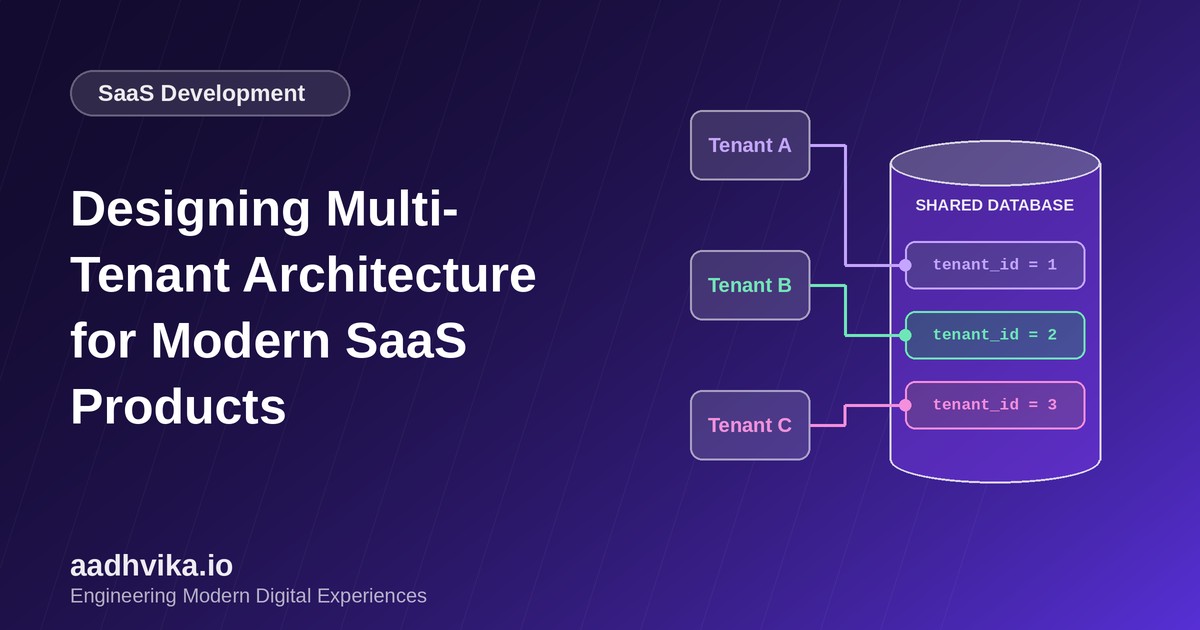
Every SaaS product eventually faces the same question: how do you serve hundreds or thousands of customers from one codebase without letting their data, performance or configuration leak into each other? The answer is multi-tenancy, and the model you choose in the first few months will shape your costs, security posture and ability to scale for years.
What is multi-tenancy?
In a multi-tenant system, a single application instance serves multiple customers (tenants). Each tenant sees only their own data and can often customise branding, roles and features, while you operate one platform instead of one deployment per customer.
The three common data isolation models
1. Shared database, shared schema
All tenants live in the same tables, separated by a tenant_id column. It is the cheapest and simplest model to run and migrate, and it scales well to a large number of small tenants. The risk is that a missing WHERE tenant_id = ? clause becomes a data leak, so isolation must be enforced centrally, for example with row-level security in PostgreSQL or a query layer that always injects the tenant filter.
2. Shared database, schema per tenant
Each tenant gets its own schema inside one database. Isolation is stronger and per-tenant backups or exports are easier, but migrations must run across every schema, and very high tenant counts can strain the database catalog.
3. Database per tenant
Each tenant gets a dedicated database. This gives the best isolation, simple compliance answers and noisy-neighbour protection, and it is popular for enterprise customers. The trade-off is higher infrastructure cost and more operational work in provisioning, monitoring and migrating.
How to choose
- Many small customers, low price point: shared schema with row-level security.
- Mixed customer sizes: a hybrid, with shared infrastructure by default and dedicated databases for enterprise plans.
- Strict compliance or data residency needs: database per tenant, or per region.
Practical guidelines we follow
- Resolve the tenant once per request (from subdomain, JWT claim or header) and pass it through a request context, never as an ad-hoc parameter.
- Enforce isolation at the lowest layer you can, such as database policies, not only in application code.
- Add per-tenant rate limits and quotas so one heavy customer cannot degrade everyone else.
- Design cache keys, file storage paths and background jobs to include the tenant identifier.
- Write automated tests that try to read tenant A's data while authenticated as tenant B.
Conclusion
There is no single best multi-tenancy model, only the one that fits your customers, budget and compliance needs. Start simple, keep tenant context explicit everywhere, and design your data layer so that moving a large customer to dedicated infrastructure later is a configuration change, not a rewrite.